Showing posts with label travel guide. Show all posts

Friday, May 16, 2014

Japan Trip: Food Escapades

One of the best parts of travelling is trying out all sorts of food. For me a trip to anywhere (especially out of the country) is never complete without sampling local dishes and snacks. As much as possible, I would prefer to avoid eating at the usual fast food places, although they're always a good go-to place when all else fails.

When in Japan, having Japanese food is a must. Although Japanese restaurants are fairly common here in the Philippines, nothing still beats having authentic Japanese food in Japan. Food is taken very seriously in this country, and the number of Michelin-starred restaurants in Tokyo alone can attest to that. You can also see it in the way the Japanese prepare their food. A lot of measures are taken to ensure that the dishes are made with the finest and freshest ingredients.

Let me take you on a virtual food adventure during our trip to Japan:

Philippine Airlines

We left Manila shortly before 7 o'clock in the morning. We were served breakfast--beef curry with rice, along with a fruit cup and cake from Perfect Endings for dessert. It was decent, but not exactly too memorable. 


On the other hand, lunch on the way back to Manila was INCREDIBLE! I chose the Beef Yakiniku with rice, a bread roll, and salad made with tofu, meatballs and some vegetables (not sure which ones). The beef was very tasty and the rice was drizzled with nori (Japanese seaweed) on top which made it very flavorful.


The salad up close--I actually had two of these since my brother (who's not into veggies at all) didn't touch his. It goes really well with the main dish!


After the meal, the flight attendants began distributing these small tubs of Japanese vanilla ice cream for dessert. What a great way to end the meal--this was definitely the best in-flight meal I've ever had! Good job, Philippine Airlines!


Around Tokyo
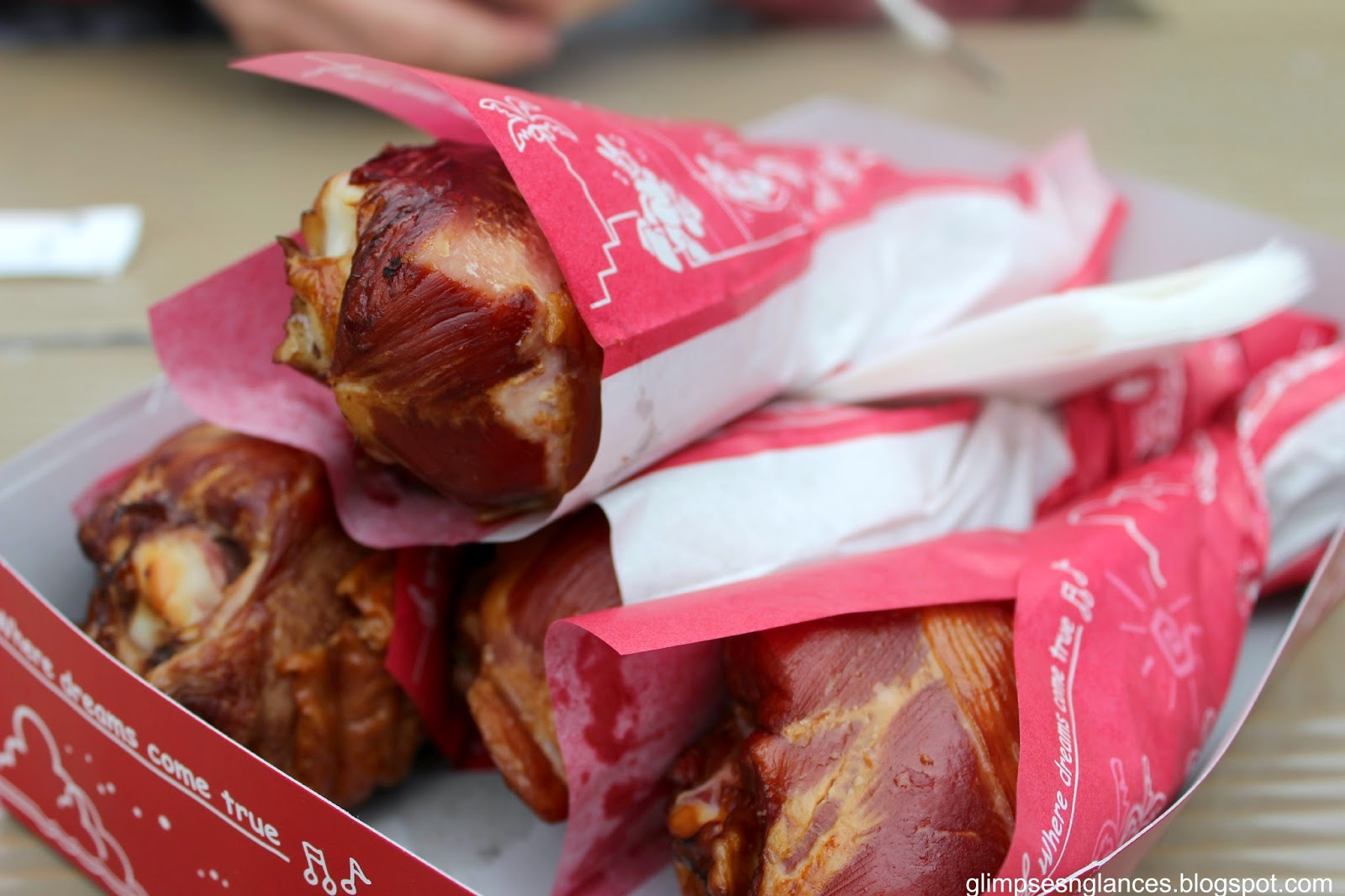
Walking around Tokyo Disneyland surely made us hungry! We bought these smoked turkey legs for our mid-afternoon snack at Y520 each (around P200)--much cheaper compared to the turkey legs they sell at Universal Studios Singapore which cost $13, or around P400,


On the day of our city tour around Tokyo, we stopped for lunch at this Parisian-inspired food court called Marche de Metro, located at a train station (underground) at Omotesando. I bought this Ratatouille Curry dish at one of the food stalls called Bistro Lyon. It was a bit (but not too uncomfortably) warm at the time, so eating this spicy dish did make me sweat a bit more. The food was still quite good, though.


Too cool off, I got this chocolate milk tea drink from this nearby stall called Vietnamese Cyclo.


On our third day in Tokyo, we had dinner at this place called Tonkatsu Wako, located at the Sunshine City Alpa, one of the two major shopping malls connected to our hotel. 


My mom's Ebi-Furai Gohan (around Y1188 or P510). Each tray comes with a bowl of rice, pickles, miso soup, and cabbage. They also serve complimentary green tea.


My dad, brother and I each had an order of Rosukatsu Gohan (also priced at Y1188). By the way, the rice, cabbage and miso soup at this restaurant are unlimited so you can keep asking for refills! The staff here are very friendly and helpful (but then again, who isn't in Japan, really?), and the waitress, despite her slight struggle with English, patiently explained to us the different types of dressing for the cabbage that we could choose from.


Other Food Photos

KitKats are extremely popular in Japan, and they come in all sorts of flavors--from the tame ones like Strawberry or Green Tea to the more quirky ones like Wasabi or Soy Sauce (you read that right). We also got to buy a small box of Baked KitKat (yep, that's right) which are ideally eaten only after being put inside the oven toaster for a few minutes which is supposed to turn into something like a crispy cookie. We tried to do that and it turned out to be a failure--I guess we were really just not doing it right.


In case you're wondering why KitKats are so popular in Japan, it's because it sounds very similar to the Japanese phrase "kittu katsu", which is synonymous to "good luck". Students usually eat KitKat just before an important exam for good luck.


Aside from doing some extra shopping, we finished off our remaining Yen at the Narita Airport in Tokyo (before flying back to Manila) with a quick meal at this place called Asian Cafe Bowl Bowl. I got these fried octopus dumpling balls and also got some of the ramen (on the left) which my mom and dad ordered for themselves. These dumpling balls were served piping hot.


Check out the rest of my Japan blog posts here:

Sunday, May 11, 2014

Japan Trip: Mt. Fuji and Hakone

For the fourth day of our trip to Japan, we headed over to Mt. Fuji and Hakone at the Kanagawa Prefecture, both several kilometers outside Tokyo. Unlike our city tour where it was just my family and I accompanied by a tour guide, this time we were part of a large group--three buses (all from the same tour company) full of tourists from several countries, in fact. Our bus, though, had mostly Filipino passengers, with a few other nationalities mixed in. The other buses had several Filipino passengers as well.

Since our hotel is at the northern part of Tokyo and is quite far from where the other tourists on our bus were staying, we were picked up from our hotel at 7:20 AM, and the next 60-90 minutes were spent going to different hotels around Tokyo to pick up all the other tourists. We were then brought to a drop-off point somewhere in Tokyo, where we boarded another bus that would actually take us to Mt. Fuji and Hakone. Our first stop, Mt. Fuji, is more than an hour away from Tokyo by car.

Here are some photos I took along the way:

The streets of Ginza were empty on Easter Sunday. The long drive around Tokyo really helped me appreciate how beautiful this city is!


Ginza is a primary shopping district in Tokyo with large boutiques and department stores. This Gap store was just one of the many multi-level standalone stores that I saw in Ginza.


Since the March 2011 earthquake and tsunami which resulted in the world's worst nuclear disaster since Chernobyl, some Japanese have begun protesting against nuclear energy. This photo was taken in a part of Tokyo where several government offices are located.


Instead of travelling on the expressway throughout the journey, the drivers of the three buses decided to take a detour to avoid a massive traffic jam caused by a major car accident. This made the trip a bit longer than it should have been, but at least we were able to get a glimpse of the smaller towns outside Tokyo, such as this one.


We made a quick stopover at a rest-stop at one point. We were given fifteen minutes to go to the bathroom, buy some snacks, or just stretch our legs. I got this pack of chocolate-covered wafers (?) at the supermarket, and this small bottle of milk tea from one of the vending machines. This brand of milk tea is actually available here in the Philippines--I was able to buy a (larger) bottle of it at the international food section of the supermarket at SM Aura Premier for P99.


After the stopover, we passed through several more towns and cities including Hamamatsu, the birthplace of famous car brands such as Honda and Suzuki. As we moved closer to Mt. Fuji, however, we began to see less houses and more trees and, as we moved higher up the mountain--snow!


As we moved further up the mountain, the patches of snow on the side of the road grew larger.


There are a total of 10 "stations" for tourists on Mt. Fuji. Regular tourists (those who arrive on tour buses in large groups) are normally allowed to go up to the 5th station, while mountaineers are allowed to go up all the way to the 10th station. However, on the day we were there, we were only allowed to go up to the 2nd station because of poor visibility and heavy snowfall. We never even got to see Mt. Fuji (and its perfect, snow-covered cone) at all! Thick fog and less-than-pleasant weather accompanied us for the rest of the day. Bummer.


My first encounter with snow--and I was totally unprepared for it! See how underdressed I am? It was freezing and it felt like my fingers were going to fall off!


Before moving on to the next part of the tour, we first had lunch (a set grilled chicken meal) at the (rather empty) Hakone Lake Hotel, after a 30-minute drive from Mt. Fuji. Earlier on in the day, our tour guide, Kumiko, went around the bus asking each of the passengers whether we wanted the set meal or not. Those who weren't really interested in the set meal were dropped off at a restaurant near the pier at Lake Ashi, which was actually where we were headed to after lunch.

The staff at the hotel were well-prepared to handle three busloads of hungry tourists--when we got to the hotel, all we had to do was to tell them our bus number (in our case, we were on bus #3) and our last name and we were immediately directed to our pre-assigned table. It was very organized.


Our set meal--grilled chicken, shrimp and pasta with potato wedges and vegetables on the side. The meal also included two bread rolls, soup, and one slice of fruit and a small cake for dessert. That's A LOT, isn't it? I was actually pretty satisfied with the meal, and I was able to finish off everything except for the shrimp.


The next part of the tour--a cruise across Lake Ashinoko (or Lake Ashi) on board these pirate ships!


On a clear day, passengers on the ships are supposed to get a nice view of Mt. Fuji, as well as the beautiful temples along the shore. Unfortunately, all this fog prevented us from seeing anything. Ugh, another epic fail.


Sailing across the lake on a pirate ship in near-freezing temperatures was still quite an experience, though. It was the coldest I've ever been in my life!


This guy's lucky he never feels cold. Pfft.


Our next stop was the Hakone Ropeway for an 8-minute ride on a Sky Gondola/cable car that would take us up a mountain. Again, on a clear day the ride would have given us a great view of Mt. Fuji, but...yeah. Fog. 


Behold--the lovely "view" from the cable car. Epic fail? Pretty much, yeah.


It was so cold that I had to get a cup of coffee to warm myself up. As I was getting the sugar and creamer, I saw this. That's Engrish for you, folks.


We were able to fulfill our tourist duties here, by buying some souvenirs and some Japanese snacks such as black kuro-tamago eggs from the Owakudani Valley in Hakone, which, according to legend, will add seven years to one's life when eaten.


Before finally heading back to Tokyo, we first stopped at a train station where several passengers of the three buses got off to take the Shinkansen (bullet train) back to Tokyo. Those who chose not to take the train (my family included) still had to get off the bus anyway and board one of the two remaining buses (one bus was heading straight to the tour company's garage) depending on where our hotels were located. Again, just like on the bus we were on earlier, the passengers were mostly Filipinos (including this rather lively Cebuano family who were chatting among themselves non-stop throughout the nearly two-hour ride back to Tokyo), although there was also a group of Australians and a solo female traveler from somewhere else. 

A small token of appreciation from the company that owns the pirate ships. This was distributed to us while we were on our way to the train station.

We were the last ones to be dropped off (as expected), so we reached our hotel at past 8 pm. I didn't mind though--at least I got to see the different parts of Tokyo all lit up at night! Too bad I wasn't really able to take decent photos. 

Up next : Food Photos!

Sunday, April 27, 2014

Around Tokyo: Ikebukuro and Shibuya

Among the cities I have been to so far, Tokyo definitely ranks up there along with my two other favorite cities, Singapore and New York. This city is incredible! For a city of over 13 million, I am so amazed at how clean it is, with a very efficient public transportation system, friendly and courteous people, and a never-ending feast for the senses for both tourists and locals alike. You will never run out of things to do here, and there are always seems to be something new for you to see!

This blog post is the second of a series of Japan-related posts (see the first one here), and there will be more coming up. Please do watch out for them!

Ikebukuro

The hotel we stayed in, the Sunshine City Prince Hotel, is located at the northwestern side of Tokyo, in a busy district called Ikebukuro. Our hotel is located in a part of the district called Sunshine City, a massive complex with office buildings, a hotel, and large shopping centers (think Eastwood City in Libis). The hotel is extremely popular with Chinese tour groups, and there were quite a number of Russian tourists staying there as well. The lobby is always so busy (and noisy)!


Our two rooms (both with two single beds each) were located at the 24th floor, and we were treated to this great view of the city each time we looked out the window. The view looks amazing at night, too.


Even if our hotel is a bit further away from the more tourist-y districts of Tokyo like Shibuya, Shinjuku, Ginza and Harajuku, there's still lots of things to do within Ikebukuro itself. This pedestrian-only street (called the Sunshine 60 Dori Strip) is just a 5-10 minute walk from our hotel, and is full of large shops and restaurants.


See how bustling this place is even during the late hours?


For all you Uniqlo fans, there is a massive, multi-level store along the Sunshine 60 Dori Strip. This particular store is one of the largest in Tokyo, and boasts of one underground level and six levels above ground, so that's a total of seven levels. Seven!


The Ikebukuro Station of the JR Yamanote Line was the starting point for our train journey for where we were headed: Shibuya!


Shibuya

Shibuya is one of the more popular districts of Tokyo. The most popular attraction here would definitely have to be the extremely busy pedestrian crossing just outside Shibuya Station. This place is also a popular shopping district with large department stores and flagship stores of several well-known brands, and it is also a popular nightspot with numerous bars and restaurants. You shouldn't dare miss out on this place!


First order of business: Check out the famous pedestrian crossing. This photo was taken just as the traffic lights turned red and the people were just beginning to cross.


And...go!


This pedestrian crossing gets even crazier when it gets dark! See it as recorded by my dad below:


The Starbucks branch just above the Tsutaya sign you see on the photos and video is one of the busiest Starbucks stores in the world. You can always try your luck if you can score some seats overlooking the streets so you can get a better view of the madness below! 


Some more scenes while walking around Shibuya:


I also took this one last photo before we decided to call it a day and took the train back to Ikebukuro:

It looks and feels just like Times Square in New York!


Stay tuned for the next part of our trip!

Tuesday, November 6, 2012

Up in the Clouds Part 2: Baguio City

Baguio City isn't probably your usual weekend getaway. First of all, it's just too far away. It is about 250 or so kilometers away from Metro Manila, and it is a 5-8 hour drive depending on the traffic conditions and also on how many stops you make along the way (and trust me, you cannot make it to Baguio without making any stops to eat or go to the restroom). Second of all, well, it's too far. If you want to get out of town just to escape the heat of the lowlands then you might as well go to Tagaytay in Cavite instead, which is just an hour and a half away from the city.

So, why do people still go to Baguio anyway? Well, it is for the very same reason, I guess--it's too far. Since it is too far away, people don't get to go there as often, unlike Tagaytay (I myself have been there thrice in the past year alone). The long trip to Baguio is still worth it anyway, since it is a larger city and there are more sights to see and things to do. Tagaytay seems to be more of a food destination than anything else to most. 

And with that, I now present to you this blog post, which covers just some of the things to do and places to go in the City of Pines. And trust me--there are lots more places to go; we just didn't have enough time to explore them. So, read on.


Wednesday, May 16, 2012

Things to Do, Places to Go: Bohol

We're down to our last few weeks of summer here in the Philippines (in fact, it's already been raining almost everyday these past few weeks now), but that doesn't mean the fun has to stop. Before the summer ends (and before the kids start heading back to school again for nine months), wouldn't it be just great to head out somewhere and enjoy these remaining weeks of pure summer bliss? 

Fortunately, you do not really have to head out of the country to have the best vacation of your life--the Philippines has 7,107 islands which you can discover and explore. 


Bohol, an island province in the Visayas, has in recent years already become one of the country's vacation hotspots attracting both local and foreign tourists. Aside from having beaches that are less crowded than Boracay (which is a big plus for those who just want a peaceful time at the beach), Bohol is also known for its attractions such as the Chocolate Hills, the cute Tarsiers, and the historical Baclayon Church. A trip to Bohol would not be complete without seeing these "icons".

However, that is not all that this province has to offer. I have a list of alternative places that you could go to (aside from the usual attractions and activities), which are also certainly worth checking out, that would certainly make your trip to Bohol a most unforgettable and memorable one. 

1. See the Loboc River from a Bird's Eye View


Many guidebooks will tell you that you should go on a cruise along the Loboc River and enjoy the breathtaking views of the mountains and trees while having lunch or dinner, while being serenaded by singers with their guitars. However, if you're more adventurous and would like to try something new, then you might just want to give ziplining a try. 

Head on over to the Loboc Eco-Tourism Adventure Park, where a zipline or a cable car ride will give you magnificent views of the Busay Falls at the end of the Loboc River. The zipline here, at 600 meters, is the longest one in the island, and takes you 100 meters above the ground. Don't worry, though--your safety here is guaranteed.

2. Go Trekking and Take a Swim at the Mag-Aso Falls


Located in the town of Antequera which is about 20 kilometers from Tagbilaran City, the Mag-Aso Falls is  relatively unknown since it is located inland and is a bit too far from the usual tourists attractions. The name comes from the local term "aso", which means "smoke". This was named as such because of the smoke-like mist that covers the falls. 

3. Go on a Food Adventure--Eat!


If touring the province has made you hungry, Bohol has a number of restaurants or cafes worth checking out. One such place is Cafe Lawis, located inside the Dauis Pilgrim Heritage Center, near the Senora de la Asuncion Shrine. It is at the town of Dauis, at the edge of Panglao Island closest to mainland Bohol. They offer a good selection of pastas, baked goodies and beverages. Worth trying are their souffles which are available in Kinampay, Ginger, and Tsokolate Eh flavors. These take a while to prepare but they are most definitely worth the wait. 

Other must-visit places include Hayahay Pizza located at Alona Beach at Panglao Island (which claims to serve the best pizzas in the island), Saffron Restaurant and Bar at the Amorita Resort also at Panglao (where they have a wide selection of gourmet dishes which you can enjoy while enjoying the view of the beach or the sunset), and The Buzzz Cafe at Island City Mall at Tagbilaran (which basically serves the same delicious, organic treats from the Bohol Bee Farm such as the Malunggay Ice Cream or salad made out of flower petals).

4. Appreciate its History


Bohol has a number of old churches which date back to the Spanish colonial period. The most popular of these is the Baclayon Church, which is most often visited by tourists. There are, of course, other Churches that you may check out. The Church of Our Lady of Light at the town of Loon (25 kilometers from Tagbilaran City) is the biggest Church in Bohol. What was originally a chapel built in 1753 under the leadership of Fray Manuel de Elizalde has become an architectural marvel built by the Augustinians. 

The Church of San Pedro at Loboc, meanwhile, is the second oldest Church in Bohol, built in 1602 (and rebuilt again in 1638 following a fire). The ceiling of this Church is adorned with paintings. Adjacent to it is the Museo de Loboc at the third floor of the convent which contains statues and other religious artifacts. 

5. Enjoy Nature--Up Close


Philippe Tariser at Panglao Island is a mixed-use property owned by husband-and-wife tandem Nicolas and Patricia Moussempes. The place has a large botanical garden, a mini-zoo, a museum (that contains, among others, actual paintings from 16th century Europe and pottery, statues or carpets from India, China, or Indonesia which dates back to ancient times), restaurants, cafes, and an events place where you can hold wedding receptions, birthday parties or other similar events). A tour, which takes about 2-3 hours, takes you around the place to view the beautiful landscaping conceptualized and handled by the owners themselves, as well as an extensive collection of pottery and statues acquired by the owners from their numerous trips abroad. You may check out my review of Philippe Tarsier here.

You may also want to visit the Simply Butterflies Conservation Center at the town of Bilar, which houses over half of the 300 species of butterflies found in Bohol. The conservation center also houses several species of birds such as the Collared Kingfisher and the Spotted Dove. The night safari tour, meanwhile, allows you to check out several species of nocturnal animals such as owls and bats.

Bohol is a mere one hour flight from Manila. Philippine Airlines flies from Manila to Tagbilaran three times a day; Cebu Pacific flies 2-3 times a day (depending on the day of the week); Zest Air and AirPhil Express fly twice daily each. 

LinkWithin

Related Posts Plugin for WordPress, Blogger...